Shelf-stable canned foods depend on a thermal process that reaches the slowest-heating point in the container. Heat penetration testing measures the temperature at that point during real retort or pasteurisation cycles, so you can prove the process delivers the required lethality — and adjust it with confidence.
Heat distribution vs heat penetration
- Heat distribution tests measure temperature around the containers, across the retort or vessel, to find its coldest zone.
- Heat penetration tests measure temperature inside the containers, at the product's cold spot, to determine how quickly the product heats.
Both are needed to establish and validate a thermal process.
The equipment
A canning process temperature logger must sit on the container with its probe inside, without leaking. That needs three things:
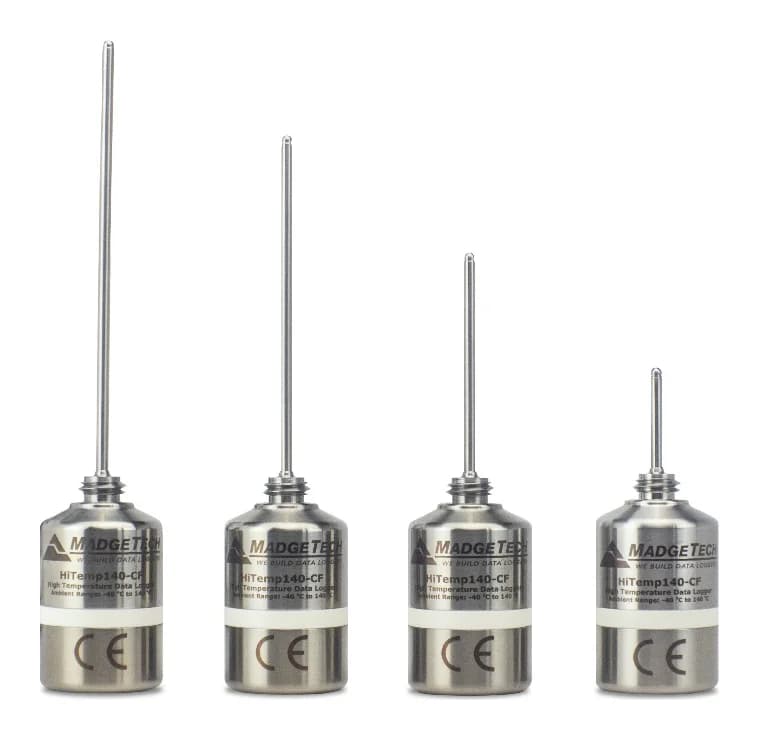
- A heat penetration logger — the HiTemp140-CF is submersible, withstands up to 140 °C and is designed to attach to containers through a canning fitting.
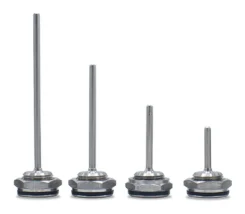
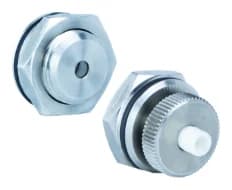
- A fitting that seals the container — the CF202 canning fitting mounts the HiTemp140-CF on jar lids, cans and other containers (the CF200 does the same for HiTemp140-FP, -PT and transitional diameter models).
- A holder for difficult packaging — the ThermaLock supports cans, jars, bottles, Recart cartons and pouches, and keeps the probe tip precisely at the cold spot.
Method in brief
- Find the cold spot. For conduction-heating foods (thick purées, solid packs) it is usually near the geometric centre; for convection-heating liquids it is usually lower down. Confirm with preliminary runs.
- Prepare test containers. Fit the logger and fitting, fill with product exactly as in production, and seal.
- Place test containers in the slowest-heating zone found by heat distribution testing.
- Run the process under normal conditions, repeating across several runs.
- Analyse the data. Calculate lethality (for low-acid foods, F0 at a reference of 121.1 °C) and confirm the process meets your target with a safety margin.
Tips for reliable results
- Use the shortest probe that reaches the cold spot — the probe should not touch the container wall.
- Check fitting seals every run; a leak changes how the product heats.
- Keep logger calibration current — see our calibration services.
- Replace batteries before critical studies; the HiTemp140 series uses the ER14250-01 battery.
This guide is part of our
Food Processing